A repeated pattern beside an enzyme
Viruses that infect bacteria, called phages, carry genes that researchers are still trying to understand. One such gene encodes a reverse transcriptase, an enzyme family best known for copying RNA into DNA. Earlier work had identified a related enzyme in the MarsHill phage and suggested that an adjacent stretch of DNA might make a noncoding RNA. It had not described the repeating pattern within that stretch. [3] [1]
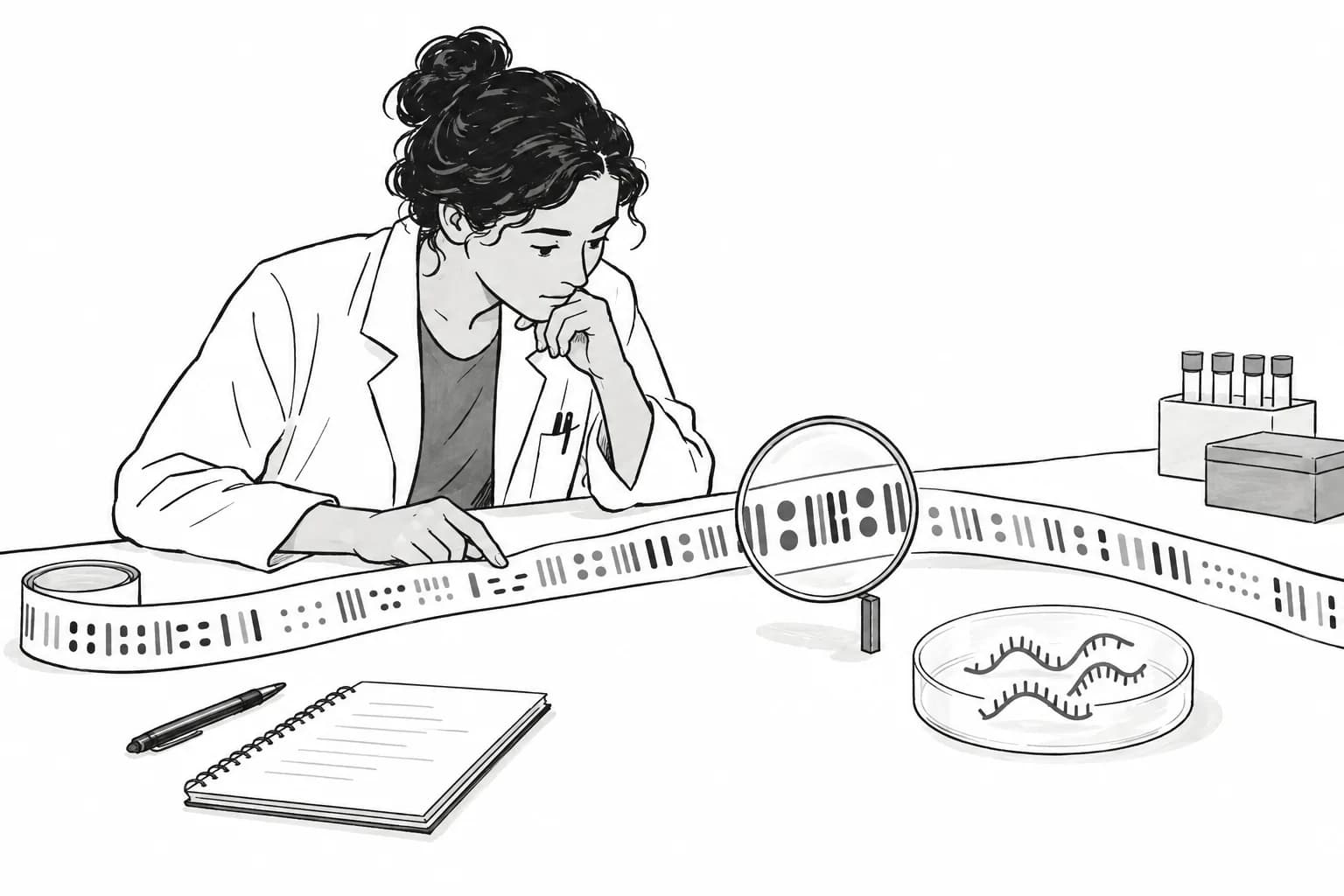
Anthropic researchers asked Claude agents to search large genome datasets for unusual reverse-transcriptase systems. While reading DNA around one candidate, an agent noticed a regularly spaced set of repeats. The agents investigated the pattern and reported it for human review. The researchers then studied related sequences and called the resulting family array-associated reverse transcriptases, or ART. [1]
The array produces short RNAs
The team found 95 distinct ART enzyme clusters in its search, 28 with a detectable repeat array upstream. To see whether an array was expressed, the researchers reanalyzed previously published RNA data from bacteria infected by a phage carrying ART. They also placed an ART locus in laboratory E. coli and sequenced its small RNAs. The array produced several distinct short RNA pieces in these experiments. [1]
Finding RNA pieces does not show that the enzyme uses them. The paper does not establish ART's biological function. [1]
What the AI contributed
The computational campaign ran 949 agent sessions over 21.5 hours and used 215.6 million tokens, according to the preprint. Those figures describe the scale of the search, not the strength of the biological evidence. Scientists chose the broad question, assessed the agents' reports and carried out the laboratory work. The distinctive AI contribution was noticing a pattern in raw sequence data and following it as a possible discovery. [1] [2]
Similar to CRISPR in shape, with a different story to test
ART has repeats separated by other sequences, a layout that brings CRISPR arrays to mind. Its spacing and organization differ, and the study found no nearby cas genes. A separate September 2026 preprint describes RNA arrays beside a different reverse-transcriptase family, UG27; that is related context, not confirmation of ART's function. [1] [4]
The authors have not shown that the ART enzyme is active, that it uses the short RNAs, or what the system does for a phage. No DNA-cutting or gene-editing activity was demonstrated. The preprint is an early report from the group that made the finding; functional experiments and independent scrutiny are still needed. [1]
Sources & context
The primary source is a 40-page author preprint linked from Anthropic's dated announcement. The earlier phage paper and the separate UG27 preprint clarify what was already known and what remains untested; neither is independent replication of ART.
Autonomous AI agents discover reverse transcriptases with tandem repeat arrays
Peter H. Yoon and colleagues · Anthropic author preprint · announced September 23, 2026
Claude discovers a novel enzyme system with CRISPR-like repeats
Anthropic · September 23, 2026
Comparative Genomics of Three Novel Jumbo Bacteriophages Infecting Staphylococcus aureus
Korn and colleagues · Journal of Virology · 2021
Coevolutionary mining of prokaryotic non-coding elements with a genome language model
Li and colleagues · bioRxiv preprint · September 23, 2026