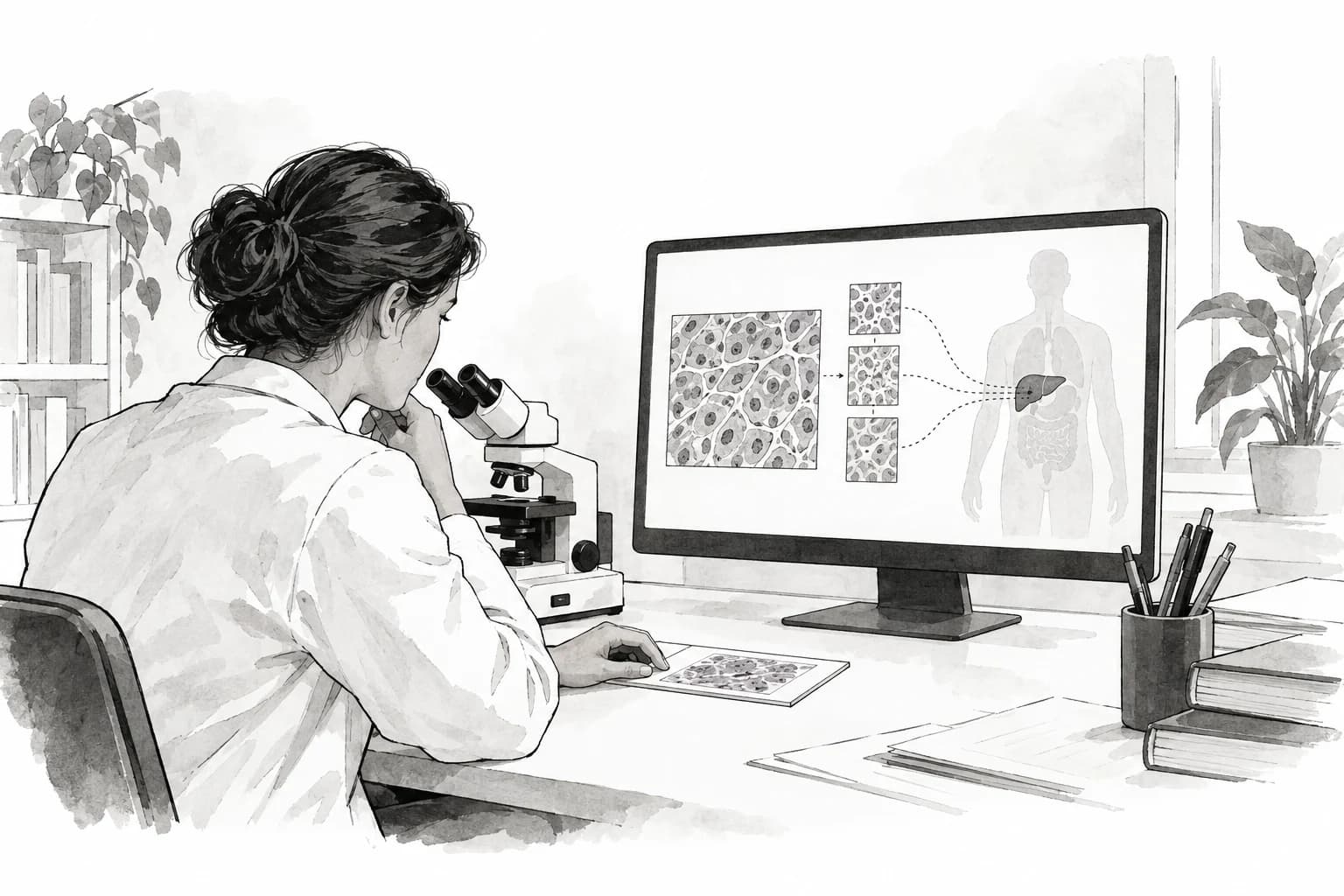
When the starting point is unclear
Cancer treatment often depends on where a tumor began. That answer can be difficult when cancer has spread or when a biopsy does not fit one clear tumor type. This study examined whether molecular data already collected during tumor profiling could give doctors another clue. [1]
The system did not make a diagnosis on its own. When its prediction disagreed with the submitted diagnosis, a molecular pathologist reviewed the case and looked for supporting evidence such as imaging, tissue staining, characteristic mutations, gene fusions or viral reads. [1]
What the model reads
The model combines two kinds of molecular information from a tumor sample: changes in DNA and patterns of gene activity measured through RNA. It learned associations between those measurements and 90 reportable cancer labels from 201,612 previously profiled cases. [1]
The model proposes a likely tissue of origin. A pathologist still has to decide whether the prediction makes sense alongside the rest of the patient's evidence. [1]
What happened during routine use
The researchers tested the model retrospectively and prospectively, then examined eight months of routine use. Among all cases profiled during that period, the review process led to a changed diagnosis for 704 patients, or 0.88 percent. These were unusual cases where the model's disagreement triggered a closer look, not a change applied to every patient. [1]
704 diagnosis changes
Cases changed after review during the first eight months of use, equal to 0.88 percent of all profiled cases.
606 eligibility changes
Among those 704 cases, the revised diagnosis changed eligibility for a targeted therapy supported by the paper's level 1 evidence definition.
A physician survey received 97 responses. Fifty-two respondents said the result prompted a treatment-plan change. Because the response rate was about 10 percent and respondents were selected by convenience, the survey cannot show how often this would happen across all clinicians or hospitals. [1] [1]
What the study does not establish
The study did not have enough follow-up to determine whether using the system improved survival or other patient outcomes. It also excluded samples that could not undergo molecular profiling, including some biopsies with too little usable tissue. [1]
The work came from Caris Life Sciences, the company that developed and operates the test. The authors reported employment and stock interests, and two authors reported a pending patent. External evaluation in other laboratories would help show how well the approach travels beyond this setting. [1]
Sources & context
One company-led original study. The archive and publisher links are two versions of the same paper, not independent confirmation.
GPSai: A Clinically Validated AI Tool for Tissue of Origin Prediction during Routine Tumor Profiling
Ghani and colleagues · Cancer Research Communications · September 1, 2025