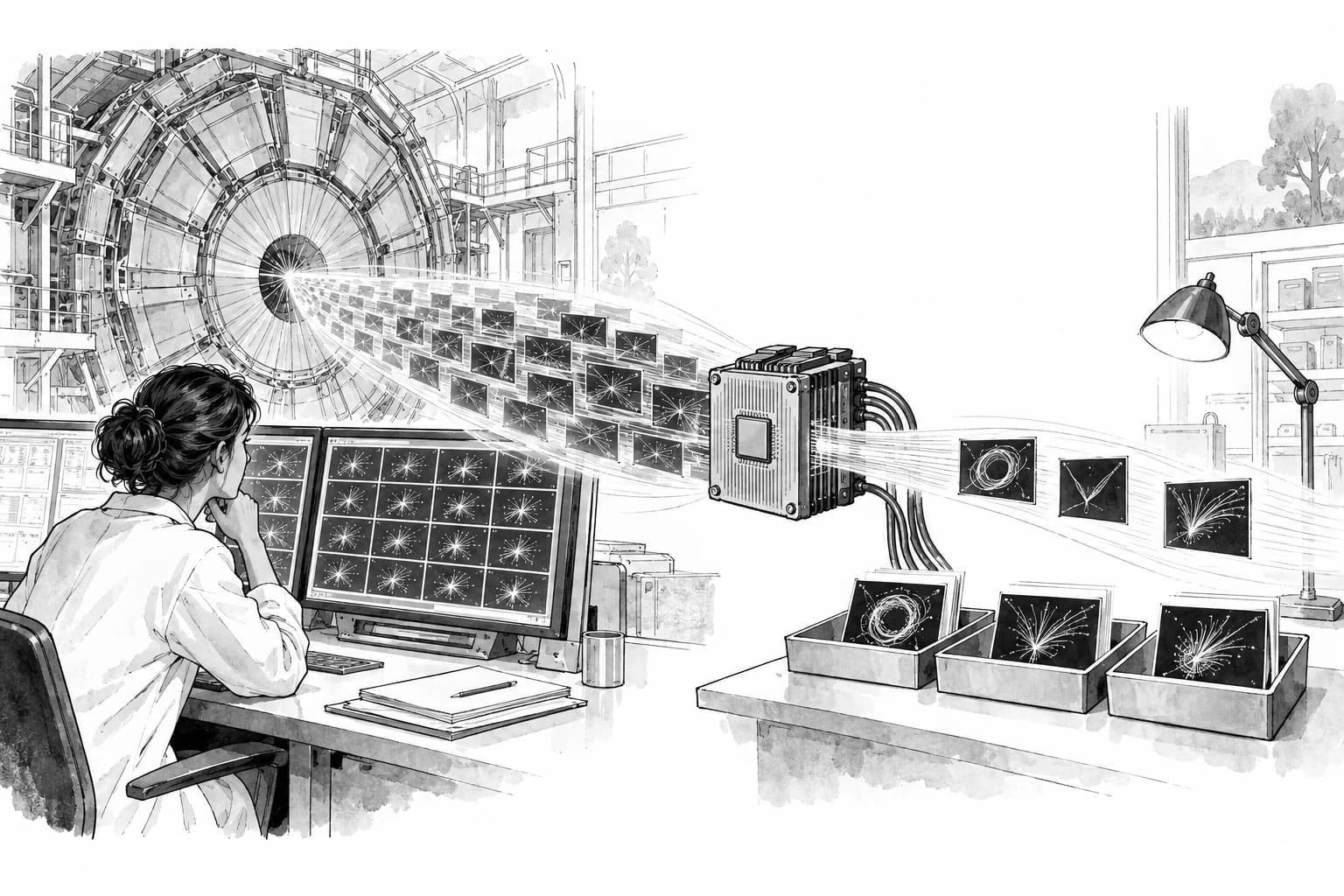
A detector cannot save every collision
Particle colliders produce events far faster than researchers can permanently store them. Trigger systems must decide almost immediately which measurements might be worth keeping. A filter trained only on familiar patterns could also discard the unexpected event researchers hope to find. [1]
This study used an autoencoder-style anomaly detector that learns common Standard Model patterns and gives unusual events a higher score. The researchers converted the model into a forest of decision trees that could run directly on a field-programmable gate array inside a fast trigger system. [1]
Fast enough for the trigger hardware
30 nanoseconds
Measured inference latency on the tested FPGA implementation.
Percent-level resources
The design used a small fraction of the selected FPGA's available resources.
Tests with simulated exotic Higgs-decay signals showed that the score could retain some unusual events while rejecting much of the familiar background. That demonstrates a possible filtering method, not an observed Higgs decay or a new particle. [1]
Simulation and hardware tests come before discovery
The physics performance depends on simulated signal examples, detector inputs and the threshold chosen for keeping events. Real collision data can contain noise and detector effects that a simulation does not reproduce perfectly. [1]
The model decides which events look unusual. Physicists must still calibrate the detector, inspect the retained data and test whether any excess has a conventional explanation. [1]
Sources & context
The journal article and preprint are versions of the same hardware and simulation study.
Nanosecond anomaly detection with decision trees and real-time application to exotic Higgs decays
Roche and colleagues · Nature Communications · April 26, 2024