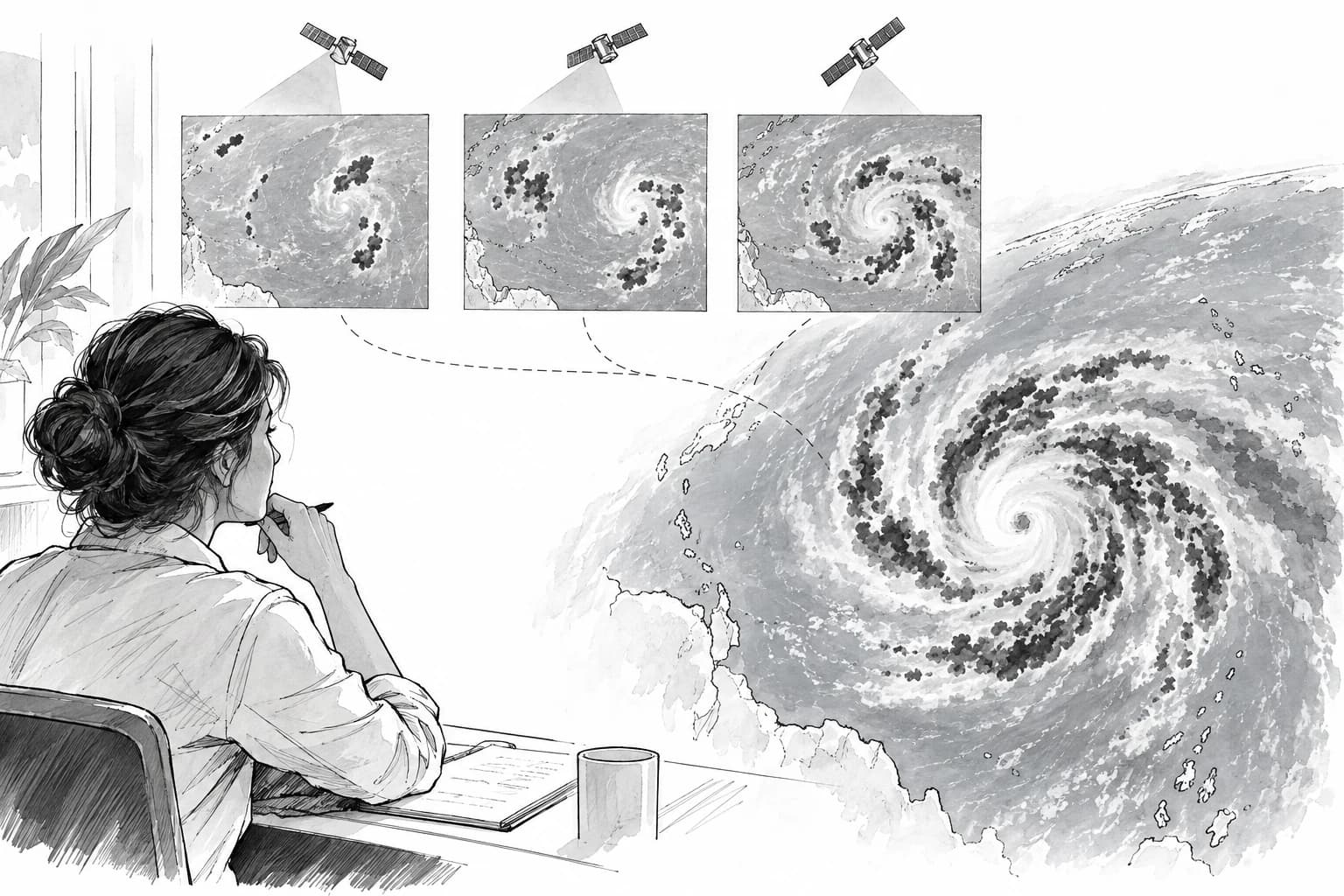
Learning from observed rain
Laxmi learns rainfall from satellite estimates rather than the rainfall field in ERA5, a reconstruction of past weather. It still uses ERA5 for other atmospheric information. The study reports better rainfall forecasts in retrospective tests. [1]
How satellites help fill the gaps
Rain gauges cannot cover every ocean or remote landscape. NASA's IMERG combines estimates from several satellites to build a much broader record of precipitation. These are processed estimates, not a photograph showing exactly how much rain reached every patch of ground. [2]
IMERG comes in versions with different delays. The Final product takes longer because it incorporates additional information and adjustments using rain gauges. NASA recommends it for research, where waiting for the fuller record is acceptable. Data useful for checking yesterday's weather is not necessarily data available when tomorrow's forecast must be issued. [2]
What was tested
Training used data through 2023; later years were held out. The authors evaluated forecasts against IMERG and examined tropical storms. This is a test on historical weather, not a live warning service. The strongest rainfall events still required attention to the physics-based comparison model. [1]
Why a forecast has more than one answer
Weather services often run an ensemble: a set of forecasts with slightly different starting conditions or model settings. The range of answers helps describe uncertainty. If the forecasts disagree widely, a single precise-looking prediction would hide that uncertainty. [3]
ECMWF uses this approach to express probabilities of events such as heavy rain. A probability forecast asks a different question from a simple yes or no: how plausible is this outcome among the possible ways the weather could develop? [3]
Not yet an operational forecast
Satellite estimates have biases too. The authors say real-time use needs further training for operational starting conditions. This preprint does not demonstrate reduced flood damage. It provides evidence about forecast performance, with independent assessment and practical use still separate questions. [1]
Sources & context
One primary study. NASA and ECMWF explain the observation data and forecasting concepts; they are not independent validations of Laxmi.
Improving precipitation forecasts in an AI weather model using observational data
Schmitt and colleagues · arXiv preprint · September 2026
IMERG: Integrated Multi-satellitE Retrievals for GPM
NASA · background on rainfall observations